Making Mozzarella
Look up how to make Mozzarella and like any other cheese, you will find a million different slight and major variations. There are options that take 15 minutes and others that take 15 hours. When I made it for the second time, I found myself flipping between options and ended up with a mixture of many approaches. My brain was in a distracted mood and this made it an entertaining adventure...however, I have no clear idea of what I did and what I might change next time, so generally I would advise going with one recipe and then making ever so slight changes to it over subsequent batches until it is just the way you like it!
Here is what I did...
Pasteurize 1 gallon of milk, cool to 80.
Add 1 and a half teaspoon citric acid and stir (in the future I would add citric acid to water before mixing it in.)
Heat to 91.
Add 1/4 tsp thermophilic starter. (Not every recipe includes tculture or the wait time.)
Stir well, cover and let sit for 30-60 minutes.
Add 1/4 tsp rennet mixed with 1/4 cup water and stir.
(Some heat the mixture to 105 degrees and hold for 5 minutes until the curd and whey separate, others do like I did below.)
Let set until you get a clean break (15 minutes)
Cut curd into 1/2 inch cubes and let set for 10 minutes
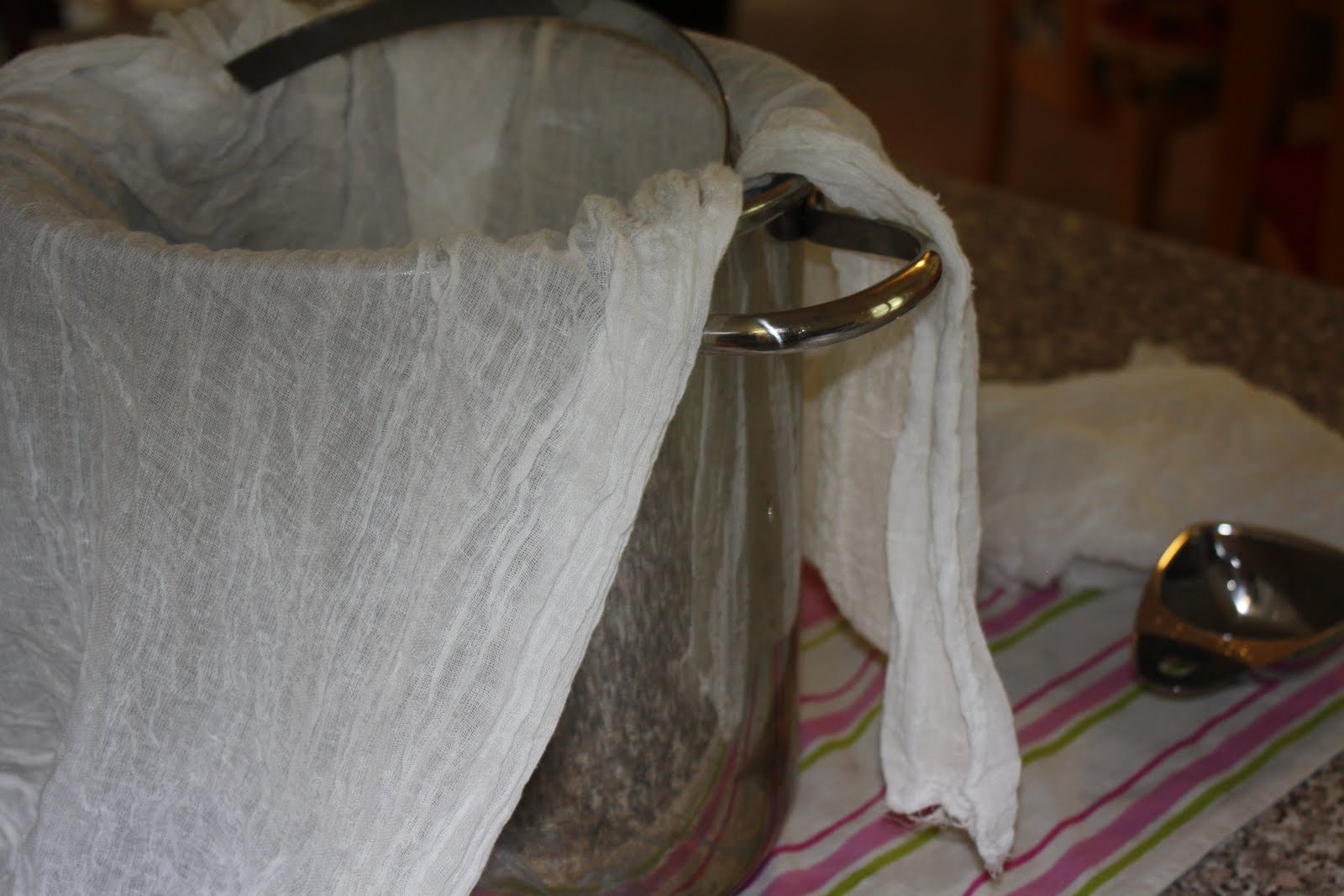
Hang curds in cheesecloth to drain for an hour
(Save whey for ricotta. To make a little ricotta -enough for a pizza- Bring pot of whey to near boil. Then pour through cheesecloth to get curds. Let drain for a couple of hours, add salt and refrigerate.)
Make curd into 3-4 balls to dip individually in very hot near boiling salted water or whey.
Dip in hot water on slotted spoon for a few seconds. If it slides out holes of spoon it is too hot, but it should want to. This part is really fun. My kids like to come into the kitchen and get in on the action. It is funny how different in texture the cheese comes out with three different people stretching the curd. Cheesemaking has a lot to do with having a gentle touch.
Try to stretch cheese gently. Let it pull down with its own weight.
Dip again in hot water.
Stretch again.
Dip again if needed.
Fold and stretch and knead Mozzarella into a ball.
Dip ball in icy water to set shape.
Salt ball and store in fridge. Or... just eat them with some sliced tomatoes and basil. The only problem with Mozzarella is that 1 gallon of milk does not make nearly enough cheese for something so yummy. Next time I'm starting with 2-3 gallons of milk.
Welcome!
I hope you enjoy reading this blog. I will never claim to be an expert on cheese making, goat milking or farming (everyday I learn something new). However, I have learned so much from others who have generously shared their experience in books and on the web and hope to use this blog to pass it on to folks considering goats. I am completely enchanted by these creatures and how they have enriched our life. The amount I have learned since we got our first two goats has been exponential. Now our herd of 21 Nigerian Dwarf Goats is a big part of our daily life and I can't imagine it any other way. This blog will chart the seasons of milking and cheese making as a record for myself and a resource to others who are looking for a window into what it is like to own these adorable mini dairy goats.
For more information about our farm, please look us up on: Our Farm Website
Or LIKE us on FACEBOOK and check often for creamery updates: http://www.facebook.com/sunflowerfarmcreamery
Monday, July 11, 2011
Friday, July 1, 2011
Summer is Officially Here!
| Olive enjoys a summer visit from Nikki and family who bought the first wethers born on our farm! |
A huge part of having dairy goats is also being parent to the doe's kids each year. As the dairy herd grows so does the number of kids each spring. Nothing is more fun than goat kids! They make getting out of bed each morning a joy and I have spent more time in the barn than anywhere else since they were born 5-6 weeks ago. With this fun also comes the responsibility of finding great homes for each of the goaties who before long we grow very attached to. People faced with the swarm of kids often ask how we know all their names. This question seems funny since we spend hours with them and know each of their personalities well. We love them individually, as much as the dogs who live in our house, and want to make sure that wherever they go, they will be treated like family. We have been so lucky in finding the best homes for our kids. All 9 wethers are now sold to people who care about their animals as much as we do. I can't explain what a relief this is!
And because of all these sweet babies now we also have milk and cheese! Today the quest for the perfect Chevre continues. It is a tasty adventure! I am working to make the cheese even more creamy and smooth and this morning varied the amount of rennet a bit since my curds were setting very quickly in the first few batches. The vegetable rennet is double strength and so I am experimenting with the perfect amount to set up my Nigerian Dwarf Goat super creamy milk! Today I mixed two drops of rennet in 1/2 cup cool water and then added 1/2 of the rennet water mixture (1/4 cup) to the gallon of milk. We'll see how this goes. So far, it is not setting up as quickly, so as long as the curds still form, I think this will be an improvement.
12 hours later...looks great. It is now hanging to drain in cheesecloth. Unfortunately I did not time this well. It should be good to go in the fridge at 3:00 a.m. Boooo. Oh well. If only those 5 does could milk themselves just one morning. By the looks of the very creamy lovely curds, it will be worth a sleepy day tomorrow!
Yum, yum, yum. Will this ever get old?
I spoke today with a woman who raises Nigerians and Mini Nubians. She loves to add orange peel to her chevre and put it in English Muffins for breakfast. I will have to try that delicious idea! Breakfast is the next frontier...a yogurt maker is in the mail!
Thursday, June 30, 2011
Marinated Feta & Mediterranean Dreams
The other night, we were standing around the barn enjoying a beer and some storytelling. The goats were all in their stalls for the night, softly chewing on hay. It was one of those perfect summer moments that you know you will look back on when the snow is piled up outside. We were chatting with the father of one of our daughter's friends who is married to a woman from Greece. It was in the darkness of a summer barn that he shared with us a tradition from her village. Each year in the weeks that garlic scapes appear, the goats are let out to graze on these tasty aromatic flowers. (This helps the farmers because the scapes have to be cut anyway to allow the energy to go into the garlic bulb.) The resulting cheese is a treat that people far and wide wait all year for and come great distances to enjoy. My mouth watered just listening to him. And now it is clear I will have to plant a garlic garden for this sole purpose, but before then, it is time to make Feta! The cheese I would most like to make is a marinated cheese that is a mix between feta and chevre. So this morning after milking I set to work fueled by visions of goats munching on fields of garlic along the Mediterranean Blue sea. Hopefully these visions will add to the success of my feta.
My recipe is an adaptation of Mary Jane Toth's from Goats Produce Too. See link above to get your copy.
Mild Marinated Feta
Ingredients:
2 Gallons Pasteurized Goat Milk
1/2 tsp DCI Supreme Vegetable Rennet (Double Strength) from dairy Connection
1/2 cup cool water
1/8 tsp Mesophilic Culture MA 19 from France (some recipes use 1/4 tsp)
(I want to try other cultures this summer and compare: MT1, MM100 and Dairy Connection Feta A)
Salt
Pasteurize Milk
Add culture at 86 degrees
Let sit for 1 hour
Mix rennet with cool water and add to milk
Cover and let set until you see a clean break 45-60 minutes.
Cut curds (see picture)
Let rest for 10 minutes
Stir curds keeping them at 86 degrees (easiest in a sink of warm water, or I used my pasteurizing vat) for 15-30 minutes
Hang curds for 6 hours
Slice into slabs 1-1.5 inches thick
Sprinkle with salt and let sit at room temp for 24 hours (turn and salt 2-3 times)
Then slice into cubes and cover with Olive Oil, garlic, basil leaves, peppercorns and other herbs.
Let sit in fridge in airtight containers for at least a week.
YUM.
Let sit in fridge in airtight containers for at least a week.
YUM.
![]() |
| 2 gallons of milk in pasteurizer |
![]() |
| culture |
| salt |
| vegetable rennet |
![]() |
| clean break means curds are ready to cut |
| cutting curds to form small uniform cubes |
| cutting curds releases the whey |
| let curds rest before stirring |
![]() |
| stir curds for 30 minutes |
![]() |
| while stirring try to keep temp at 86 degrees |
![]() |
| ready to drain |
| cheesecloth ready over colander in pot |
![]() |
| gently transfer curds to drain |
![]() |
| before draining |
| after draining |
| slice feta |
| Salt slabs and let sit. They should each have their own space, I layered them because I only had one container. |
| after 24ish hours |
| So now it's evening on the 2nd day |
| Most will add brine to feta in a jar and leave for a week (or a few) in the fridge. I decided to jump to the marinated stage. |
| cut cheese into cubes and taste |
| before adding oil |
| add the things you love to olive oil |
![]() |
| admire your creation while it sits for a week or more in the fridge to tasty up even more. |
Wednesday, June 22, 2011
New Chevre is Heavenly!
Like goats, goats owners are known to make their own path. If you need any proof of this google any goat question and you will be amazed at the wide range of answers. What should a dairy goat eat? When should the kids get their CDT shots? Should a pregnant goat get a BoSe injection in Maine? For any one question, goat owners are doing things in a million different ways and it is no different with goat cheese makers. Once a cheese maker moves beyond the no fail packages of prepared starter and rennet, you are on your own with a thousand options. (Thankfully goat owners are incredibly generous with their knowledge and experience, so you are never really alone.) While the cheese making process is amazingly simple and virtually the same no matter what type of cheese you want to make, the details matter and can produce dramatically different results depending on a million factors. This magic so appealing to me. The fact that my water, the hay the goats eat, the forage available in the field, the culture I order and how happy the goats are all play a role in what ends up on the cheese plate is a wonderful reminder that food is not something we can mass produce and still get the same delicious results. It is both simple and complicated and completely connected to the well being of the cheese maker and animal! This summer it is my goal to make cheese every other day. I will post my results on my quest for the perfect, irresistible cheese! This first one was mighty delicious, a great start to the summer.
FIRST SUMMER CHEVRE-JUNE 18
2 gallons milk
1/4 tsp DVI culture from France (Danisco MM100) for 2-5 gallons
Mixed 1/2 tsp vegetable rennet in 1/4 cup water, then used 2 tbs of mixture
(I read goat's milk needs less rennet)
•Pasteurize milk then cool to 80F.
•Add culture and let culture sit on surface for a couple of minutes.
•Gently stir with up ad down motion.
•Add rennet and stir.
•Let sit about 7 hours.
(I look for the curd to pull away from edge of pot and the whey to cover surface of curds.)
Note: This recipe is causing my curds to set up quickly, can take much longer.
In thin slabs gently transfer curds to a bag
Drain for 5 hours.
Add salt.
Put in fridge for the night.
The next morning we shape into logs and add herbs. (Dill looks especially pretty rolled onto the outside of cheese mixed with salt and Herbs de Provence.)
Notes:
Target PH for goat milk is 6.4
Our fresh milk tests at 6-7 on June 18.
We are making cheese every 2-3 days.
June 22-Getting 10 cups a day milking in the morning only.
5 does. (One gives barely any milk, one gives twice the amount of any other goat.)
Monday, June 6, 2011
Lucky 13
After an exciting two weeks of kidding, we have a busy barn full of 13 leaping baby goats. We are keeping the 4 girls (yes bad odds!) and selling the 9 wethers at eight weeks. They all have such personalities already that we know we will miss them when they go, but part of the fun is meeting all the cool families who are interested in having their own goats. The first two will be headed to York to live with a lovely couple who have had a farm for years with animals of all sizes. They brought along a granddaughter to help pick out the bucklings they wanted. Who knows who else we will meet in the coming weeks. We still keep in touch with most of the folks who bought kids and piglets last year and even received a first birthday picture of a goat we sold last year wearing a birthday hat!! He is all grown up and looks just like his mama Bonnie!
The highlight of kidding season was Tess (13 years old) being midwife to our two goats who went into labor at exactly the same time. By the time we got home, six bouncing babies were nursing and Tess had taken care of dipping their umbilical cords and making sure each goat got colostrum. She is a natural! The low point was a kid who was born unable to walk or hold up her head. We did our best: gave her a shot of BoSe, some NutraDrench, and some colostrum via syringe, then brought her in with us by the wood stove, but after watching her all night, she died the next day. It was our first goat to ever die on the farm and it was very sad. I can't imagine it getting much easier with time, but I'm OK with us being emotionally attached. And the surprise of the season: Bonnie had 4 boys! One who came out 2 hours after the rest, long after we thought she was done kidding. Lewis is one of our biggest kids and came out raring to go. Our smallest kid is also Bonnie's (her first). His name is Clyde and he is the cutest thing I've ever seen.
We began milking a couple of days ago. At two weeks we separate the kids from their moms at night and milk once a day in the morning. After we sell the wethers at eight weeks we will begin twice a day milking. And after months of waiting, the first chevre is doing its thing overnight! YUM! I could burst with excitement. I had no idea just how much I missed milking and cheese making until we got back into the action this week!
We are feeling like 13 is very lucky indeed.
Thursday, May 19, 2011
The Waiting Game...150 days since our buck's visit.

Life on a farm is a school of patience; you can't hurry the crops or make an ox in two days.
Alain, HenriIt wouldn't be so hard to wait if the arrival of kids wasn't tied up with such a variety of goodness. The first birth means the start of: fresh milk, delicious cheese, summer nights watching the antics of herd of all ages set free in the field, early mornings that for some reason feel invigorating instead of painful, hours of snuggling tiny goats in a stall, and visits from great people interested in beginning down the same wonderful road or just stepping into a different world for a few hours. There is no time of year which is so overwhelmingly rich with delicious anticipation. And yet although all five of our mama goats look nearly ready to burst, they are not quite ready to let the season begin. They tease us with plaintive bleating that suggests they are ready to give birth and then let another day pass without sharing any cute babies with us. Meanwhile the cats stay close in the stalls, touching noses with the pregnant mamas, seemingly content to wait out the next few hours or days and provide a watchful eye. Inside the house, we pretend to sleep, ears tuned to the barn baby monitor, eyes forming colorful kids and tasty containers of chevre in the darkness. In a week I'm sure part of me will look longly back on the lazy mornings of winter, but for now my patience is stretched thin and if all the does went into labor tonight I would definitely not complain!
Sunday, January 2, 2011
Drying Off, the first season winds down
![]() |
| goats with 2011 buck Allegro |
![]() |
| last moments of draining |
![]() |
| our pasteurizer at work |
A cute buck named Allegro came just before Christmas, in a dog carrier in our Prius (a ripe ride from Alfred to Cumberland). And so the cycle begins again. We could have kept milking for a few more months, but we figured deep winter was a good time to give the does, who we hope are now all pregnant, and ourselves a little break. We could have anywhere from 1 to 20 kids in the end of May or start of June. Likely we will be milking 4 does. (The buck has found ways to get out of his stall using some incredible goat magic so there is a chance our 7 month old doeling is pregnant, but we hope not. If so that makes 5 milking does.) We will likely have a gallon of milk a day and be able to make 15 cheeses every day. We will need a lot of friends to eat it!
It is easy to think of all the things we wish we had done better. Despite giving it our best try and doing lots of research, we did not disbud the kids well and had to have the 2 we sold redone. Not something I ever want to pay for or have to put the kids through again. Little Luna is a one horned wonder, a good reminder that we will have to either embrace horns or hold the iron on a bit longer next year. We had a vet do all the shots and spent a fortune on vet visits, nearly $200. each time. We never got to hard cheeses.
But then, if we sit back for a minute, we can appreciate all we have learned and tried this year for the first time. We leased our first buck, watched our 2 goats have 3 healthy kids, did our own disbudding and banding, bought two new does, learned to milk, and make cheese and cajeta and operate a pasteurizer. And on the side, delivered 4 potbelly piglets (yes I had to reach in to help), nursed a barn cat back to health in the bathroom, learned to take the temperature of a goat, pig, cat and dog. We lost one little piglet, but kept all the rest of our animals healthy and happy and even had a 100% survival rate on our 25 day old chicks. (Another first.) So if the year is measured in firsts, we have had a big one. All that while digging out our new farm and making it feel like home.
The wonderful thing about the break winter provides is it gives me a chance to recognize all we experienced and take stock for next year. Like teaching I will have a fresh try next season. And in the meantime my Hoegger Supply Catalog came and I have already dogeared nearly every page with all the farm treasures I would love to have: a cheese press, a heated bucket, all my own supplies to give the goats their vaccinations myself. Winter is for dreaming, and I can already taste all the cheeses June will bring. Thanks Allego for your help.
Tuesday, July 13, 2010
Settling into a Delicious Routine
![]() | |
| It's amazing how something totally new and overwhelming one week can soon become a natural part of life. It seems impossible that I have been milking goats for only 5 weeks! The twins are now 7 weeks old, big Dill is 8 weeks old. Twice a week I am cooking up a variety of mouthwatering chevre which never lasts long. I am now up to 7 cups of milk a day and soon will be milking all the goats twice a day...look mom 2 hands! An adorable family came by the other day to see the kids and put a deposit on Dill and Zeus, who they will name Toot and Puddles. We would have been heartbroken to let them go, except they were in many ways like a younger version of ourselves and there is something cool about imagining all the fun in store for them as goat owners. They will go to their new home at the end of the month. On an especially overzealous day, I ordered 500 deli containers so I can begin giving my cheese away to friends and last night we made a delicious new version: chevre on the bottom layer, covered with fresh pesto and a few slivers of roasted red peppers. YUM! Now as a reward for delicious goat cheese at dinner, we let the whole herd out to play. If someone starts running, they sprint after in a huge mass that can only make you laugh. They will run back and forth to the barn after the kids until they are all panting and ready for bed. Check out the video for a laugh. Chianti is still a mystery milker. To get any milk out of her, I need to hold up her udder with one hand just behind the teat and then squeeze with my free hand. This results in a slow process. I am still not getting the amount of milk that I should be. Everyone talks about the Quart for each milking per Nigerian Dwarf goat, but I only seems to get 2 1/2 cups at best. When I start to worry about this I have to laugh recalling just 5 weeks ago when I entered the kitchen proudly carrying my 1/3 cup of milk. Now a little more than a month later, I have a fridge full of fresh cheese and another month off from school. It's hard to worry too much! |
Saturday, July 3, 2010
The Long Awaited Chevre!
We added two goats to our herd, GoGo (short for Happy Go Lucky) is in milk and Tiger Lily is a sweet yearling from a good milking line who we will breed this winter. This brings us to a total of 8 goats, 3 are being milked daily. Next spring 4 will be able to have kids so we will have a barn full of babies. Because of this purchase, and my increased experience after a full month of milking, we are now in the milk! Looks like we are averaging 7-8 cups a day which means we have enough to make chevre. As the new goat settles in and our babies are weaned we will easily be able to double this amount I think. So much dreaming and planning that went into getting to this point that the cheese we made and brought to our friends' summer party last night was way more than cheese, it was a celebration of the whole past year!
The process takes almost 24 hours. After the evening milking, we put 2 days worth of milk in the pasteurizer. This beast has been laying in wait in the cupboard for some time and was ready to get to work. The directions are very old school. At the point where everything is plugged in and ready to go it says: "Now go about your business until you hear a loud buzzer." Every time I was inclined to stare at it in the 20 minute process, Chris would laugh and tell me to "Go about my business." While there is hot debate about the benefits of raw milk versus the health risks, I decided to play it safe with my cheese. I want everyone to feel completely comfortable eating it, including little kids and my older relatives whose immune systems are not as strong. I figure the fact the our cheese is made from milk that was in the goat hours before makes it infinitely healthier than anything I could buy, so I can give up the potential health benefits raw milk offers.
After pasteurizing I added the chevre packet of starter bacteria, rennet and malto dextrin. This premixed and measured packet is sold by New England Cheesemaking Supply. Later in the summer I will experiment with my own mix, but for now this makes the process super easy! Although there does not appear to be anything happening, the magic begins instantly. I cover the milk and set it out in the kitchen, and by the next morning after milking, it has formed into a substance that looks and smells a bit like yogurt.When I moved the pot, the cheese moved as one jiggly mass.
At this point I knew we were going to have cheese, but there was still another 8-12 hours wait until we could taste the product. Almost exactly a day after we had begun the process, the curds had stopped dripping whey and we were ready to add delicious herbs and arrange our cheese plate. Tess and Lila have both been helping with the milking this week and are getting really good, so we divided the cheese into 3 parts and each made our own delicious recipe. Tess used fresh and dried Dill with a citrus blend of salt. Lila used Herbs de Provence and salt, I used fresh ground black pepper, salt and rosemary. 3 girls + 3 goats + 3 days=3 delicious cheeses. We watched the cheeses like they were our children all the way to the party and observed with proud smiles as all three disappeared within minutes after arriving. MISSION accomplished! It was smooth, goatie and delicious. Honestly, I think is was better than store bought goat cheese.
Subscribe to:
Posts (Atom)